Modern India Part 1: From Plassey to 1857 Company Raj
Quick answer: Modern India Part 1 — from Plassey 1757 to the Revolt of 1857: conquests, policies like Doctrine of Lapse and Subsidiary Alliance, land settlements.
- 1. From Factory to Empire: The Arrival
- 2. The Two Battles That Won Bengal
- 3. The Machinery of Expansion: Subsidiary Alliance to Doctrine of Lapse
- 4. The Land Settlements and the Economic Rewrite
- 5. The Charter Acts: Parliament Tightens the Leash
- 6. 1857: The Revolt — Causes, Course, Consequences
- How Exams Probe This Card
- 7. Quick Revision: One-Glance Facts
- The Company Raj in One Table
- Practice Corner: Five Definition Checks (with Answers)
- The Case Lens: Answering the 1857 Question
- The Three Classic Traps (Where Beginners Slip)
- Frequently Asked Questions
- Why did the Battle of Buxar matter more than Plassey?
- What was the Subsidiary Alliance?
- How did the three land settlements differ?
- What were the main causes of the Revolt of 1857?
- What changed after 1857?
- About the Author
- References & authoritative sources
Why did a trading company end up ruling an empire?
“We hold ourselves bound to the natives of our Indian territories by the same obligations of duty which bind us to all our other subjects.” — Queen Victoria’s Proclamation, 1858
In one line: Modern India Part 1 — the Company Raj from Plassey to 1857, explained in a single read.
In one line: A century of conquest on one card — Plassey and Buxar make Bengal the base, the Subsidiary Alliance and the Doctrine of Lapse swallow the map, three land settlements rewire the villages, the Charter Acts slowly discipline the Company — and the accumulated rage detonates in 1857.
The Company Raj rests on four pillars. First, the conquests — from trading posts to empire in under a hundred years. Second, the policies — the instruments of expansion that consumed state after state. Third, the administration and the economy — land settlements, laws, courts, and the drain. Fourth, the explosion — 1857, its causes, course, failure and consequences.
Contents
1. From Factory to Empire: The Arrival
2. The Two Battles That Won Bengal
3. The Machinery of Expansion: Subsidiary Alliance to Doctrine of Lapse
4. The Land Settlements and the Economic Rewrite
5. The Charter Acts: Parliament Tightens the Leash
6. 1857: The Revolt — Causes, Course, Consequences
7. Quick Revision: One-Glance Facts
– Practice Corner: Five Definition Checks (with Answers)
– The Case Lens: Answering the 1857 Question
Quick Answer: The East India Company (chartered 1600) turned from trader to ruler in the century after Plassey (1757) and Buxar (1764), which delivered Bengal’s revenue (the Diwani, 1765). Wellesley’s Subsidiary Alliance and Dalhousie’s Doctrine of Lapse annexed the rest of the map by 1856; the Permanent Settlement, Ryotwari and Mahalwari systems reorganised land; and the Charter Acts (1813, 1833, 1853) progressively stripped the Company of its trade privileges and political powers.
Political dispossession, economic drain and military grievance fused into the Revolt of 1857 — which failed militarily, ended the Company Raj, and handed India to the Crown.
1. From Factory to Empire: The Arrival
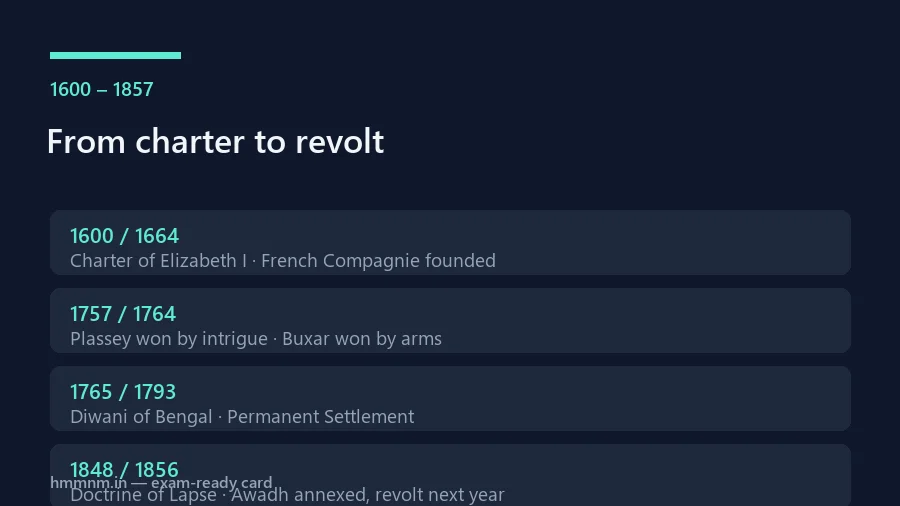
- The Europeans queue up. The Portuguese arrive first (Vasco da Gama at Calicut, 1498; Goa acquired by 1510); the Dutch follow, then the English (East India Company, chartered by Queen Elizabeth I on 31 December 1600) and the Danes; the French Compagnie des Indes Orientales arrives last (1664) — the latecomer whose rivalry with the English opens India’s political door.
- The English factories. Surat (1613, after the Mughal governor of Gujarat permitted a factory; Sir Thomas Roe’s 1615–18 embassy then secured wider privileges), Masulipatnam, Madras (1639, with Fort St. George), Bombay (1668, the Portuguese dowry of Catherine of Braganza transferred via Charles II), and Calcutta (1690, Job Charnock, Fort William) — the three presidency towns of Madras, Bombay and Calcutta that later anchor the entire Raj.
- The Anglo-French Carnatic Wars (1746–63). Three wars fought on Indian soil with Indian rulers as pawns; the third ends with the Peace of Paris (1763) — the French reduced to trading pockets like Pondicherry, the English commercially supreme and militarily seasoned. Robert Clive and Joseph François Dupleix are the pair of names to remember.
- The structural opening. Post-Mughal fragmentation — successor states, the Maratha confederacy, the Nizam, Bengal under the Nawabs — meant India was conquered not by a tiny foreign army alone, but by an army plus alliances plus revenue. That formula — conquest funded by Indian revenue — is the whole story of Part 1.
2. The Two Battles That Won Bengal
- Plassey, 1757. Clive defeats Siraj-ud-Daulah — a battle won before it was fought: the Jagat Seth bankers finance the plot, Mir Jafar commands the conspiracy, and the monsoon rain soaks the Nawab’s gunpowder while the Company’s is kept dry. Consequence: a puppet Nawab on the masnad, and the Company’s first taste of Bengal’s treasury.
- Buxar, 1764. The real military watershed: the Company defeats the triple alliance of Mir Qasim (Bengal), Shuja-ud-Daula (Awadh) and Shah Alam II (the Mughal emperor himself). Plassey gave intrigue a victory; Buxar gave arms one — and with it the Diwani of Bengal, Bihar and Orissa (1765): the Company now legally collects the revenue of India’s richest province.
- The dual government (1765–72). The Company holds the revenue powers, the Nawab retains the administration — a system of responsibility without power, and power without responsibility, that bled Bengal dry (the Great Bengal Famine of 1770 kills an estimated ten million while revenue collection continues relentlessly). Clive and Warren Hastings are the names; the structural contradiction is the exam point — and the provocation for the Regulating Act of 1773.
- Why Bengal mattered. Revenue, trade (opium to China, silk, saltpetre, textiles), and a soldier-recruiting hinterland — the base that financed every later conquest. “Bengal paid for the conquest of India” is the one-line summary to carry through the entire period.
3. The Machinery of Expansion: Subsidiary Alliance to Doctrine of Lapse
- The Subsidiary Alliance (Wellesley, 1798 onward). The prince accepts a British Resident at his court, maintains Company troops at his own expense (ceding territory when the cash runs out), expels other Europeans, and surrenders his foreign relations. Hyderabad (1798), Mysore (1799, after the Fourth Anglo-Mysore War kills Tipu Sultan), Awadh (1801) — the states become subsidiaries, their armies dissolve, their treasuries drain into Company accounts. Sovereignty survives on paper; substance evaporates.
- The Maratha wars (1775–1818). Three Anglo-Maratha Wars plus the final campaign end the confederacy — Peshwa Baji Rao II surrenders in 1818, receives a pension at Bithur, and the Peshwaship itself is abolished. The Maratha remnant states (Gwalior under Scindia, Indore under Holkar, Baroda under Gaekwad, Nagpur under Bhonsle) survive as subsidiary allies — until Lapse comes for some of them.
- The Doctrine of Lapse (Dalhousie, 1848–56). An adopted heir cannot inherit a subordinate state; on the death of a ruler without a natural son, the state “lapses” to the Company: Satara (1848, the first casualty), Jaitpur, Sambalpur, Udaipur, Jhansi (1853), Nagpur (1854) all fall; Awadh is annexed in 1856 — not under Lapse, but on the “misgovernment” plea — the final humiliation that stings the sepoy ranks and the aristocracy alike.
- The Sikh wars and the frontier. Two Anglo-Sikh Wars (1845–46 and 1848–49) end with the annexation of Punjab and the surrender of the Koh-i-Noor; Dalhousie’s tenure also adds Lower Burma (Second Burmese War, 1852). By 1856 the map is essentially Company-red — and the sheer speed of that expansion is itself a cause of 1857.
- The three-step grammar to memorise: alliance (troops and Resident) → intervention (debt, “misrule”) → annexation. Every state’s story fits the template; prelims questions only change the state’s name.
4. The Land Settlements and the Economic Rewrite
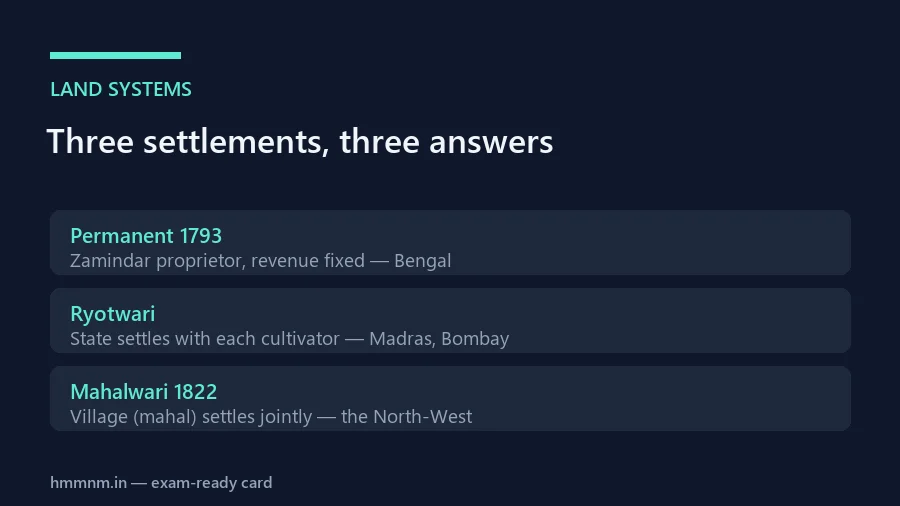
- The Permanent Settlement (Cornwallis, 1793). Bengal-Bihar-Orissa: zamindars are recognised as proprietors of the soil, revenue fixed forever at the 1793 level — the state’s income frozen while prices and land values rise, and the actual cultivator squeezed by a landlord class whose priority is rent extraction, not agriculture. The classic criticism: neither investment in land nor security for the ryot. When the zamindar defaulted, the estate was auctioned — creating a new market in land and a new class of absentee landlords.
- Ryotwari (Munro and Read — Madras, later Bombay). The state settles directly with each ryot (cultivator), revenue revised periodically by settlement officers — no intermediaries in theory, but excessive assessments and inflexible cash collection produced chronic peasant indebtedness and, later, the backdrop to the Deccan Riots of 1875.
- Mahalwari (North-Western Provinces, later Punjab and parts of Central India). The village (mahal) settles jointly, with collective liability resting on the village community — a hybrid system devised by Holt Mackenzie’s 1822 regulations and refined by James Thomason.
- The economic drain, in exam language. Home Charges (pensions, interest, India Office expenses), the “investment” system (Indian revenue used to buy Indian goods for export, with the proceeds pocketed in England), a one-way tariff policy that smothered Indian textiles while British goods entered duty-free (the de-industrialisation debate), and the destruction of indigenous shipbuilding and handicrafts. Dadabhai Naoroji’s drain theory — articulated in Poverty and Un-British Rule in India — is the nationalist account, and mains answers should quote it.
- The administrative spine. Districts under Collectors, the Cornwallis codes separating revenue and judicial functions, the police thana system, the courts (the Regulating Act’s Supreme Court at Calcutta, 1774; the later High Courts of 1862) — the “steel frame” of the Raj was assembled over this same century, and Part 1 explains the machinery that Part 2 inherits.
5. The Charter Acts: Parliament Tightens the Leash
- Regulating Act, 1773. The first parliamentary intervention: a Governor-General of Bengal (Warren Hastings the first) with a four-member council, and the embryo of parliamentary control over the Company — a direct reaction to Plassey-era plunder and the dual government’s failures.
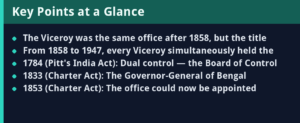
- Pitt’s India Act, 1784. Dual control: a Board of Control (representing the Crown) over civil, military and revenue affairs; the Company retains commerce — the blueprint of governance that lasts until 1858.
- Charter Act, 1813. The Company’s monopoly on Indian trade ends (the China tea trade survives until 1833); one lakh rupees a year is set aside for education — the first formal parliamentary commitment to educating Indians.
- Charter Act, 1833. The Governor-General of Bengal becomes the Governor-General of India (William Bentinck the first); the Company becomes a purely administrative trustee, its commercial life ended; legislative power is centralised; and the seeds of open competitive entry into the covenanted civil service are sown (the 1853 Act completes the work).
- Charter Act, 1853. Separates the legislative and executive functions of the Governor-General’s council; introduces open competition for the ICS (Macaulay’s committee frames the rules; Satyendranath Tagore becomes the first Indian ICS in 1863); and — pointedly — fixes no term for the Company’s rule, holding India “in trust for the Crown”. The lease is now indefinite — and 1857 terminates it entirely.
6. 1857: The Revolt — Causes, Course, Consequences
- The layered causes. Political: annexations, the Doctrine of Lapse, Awadh’s removal, Nana Saheb’s refused pension, Bahadur Shah II’s succession anxieties. Economic: the drain, de-industrialisation, ruinous land revenue demands, peasant indebtedness, the dispossession of Awadh’s taluqdars. Administrative: the courts’ alien procedures, the resumption of tax-free inam and rent-free grants. Socio-religious: missionary activity, the alarm created by reform legislation (abolition of sati, 1829; the Widow Remarriage Act, 1856; the 1850 convert-inheritance act) — reform read as interference. Military: sepoy pay and promotion grievances, the General Service Enlistment Act (1856) requiring service across the sea, the lopsided Indian-to-European ratio, and the annexation of Awadh — homeland of roughly a third of the Bengal army.
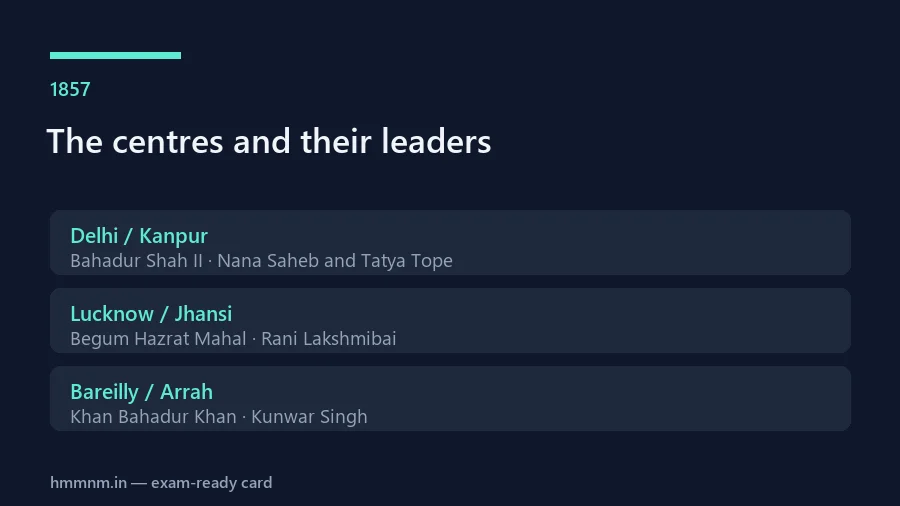
- The spark and the spread. The greased cartridge of the new Enfield rifle — rumoured to be greased with cow and pig fat — offends Hindu and Muslim sepoys simultaneously. Mangal Pandey strikes at Barrackpore (March 1857); the Meerut garrison mutinies (10 May) and marches to Delhi, where the ageing Bahadur Shah Zafar is proclaimed Emperor of Hindustan. The centres: Delhi, Kanpur (Nana Saheb and Tantia Tope), Lucknow (Begum Hazrat Mahal; Henry Lawrence dies in the Residency), Jhansi (Rani Lakshmibai), Bareilly (Khan Bahadur Khan), Arrah in Bihar (Kunwar Singh). The revolt’s geography — the Ganga-Jumna doab, precisely the Bengal army’s recruitment zones — explains both its fury and its containment: Bengal proper, Punjab, and the south largely stay quiet.
- Why it failed. No unified command or shared political programme; the Sikhs, the Gurkhas, most princes, and southern and western India stayed out (the subsidiary princes — the revolt’s quiet losers-turned-winners — actively aided the British); modern arms, the telegraph and steam navigation favoured the British; and the leaders fought regional wars, not a national one. Yet Savarkar’s “First War of Independence” label and the historiography debate (sepoy mutiny vs war of independence vs feudal reaction) remain a mains favourite — present both readings and adjudicate.
- The consequences, in order. The Government of India Act, 1858: the Company abolished, the Crown rules through a Secretary of State with a Council and a Viceroy (Canning the first). The Queen’s Proclamation (Allahabad, 1 November 1858): the princes’ adoption rights honoured, no further annexation, religious non-interference — the “Magna Carta of Indian opinion”. Army reorganisation: recruitment rebalanced towards “martial races”, artillery kept in European hands, unit composition deliberately mixed to prevent united mutiny. And the racial gulf hardens; the post-1858 era of cautious modernisation (railways, universities — the first three already in 1857) follows, which Part 2 takes up.
alliance (troops and Resident) → intervention (debt, "misrule") → annexation
How Exams Probe This Card
Prelims strips this century to its dates and pairings. Expect a
matching item between battles and their years, a settlement-and-region
pair, a Lapse-state list, and the causes-of-1857 columns dressed as
statements to mark true or false. The Charter Act sequence is the
evergreen trap: which act ended which monopoly, and which one opened
the services to competition.
Mains wants the longer arc in one frame: conquest financed by
revenue, revenue organised by three settlements, and grievance
compounding until the army broke. Quote Naoroji on the drain, name
the three-step grammar of expansion, and close on the 1858 transfer
as the argument the revolt lost but won.
7. Quick Revision: One-Glance Facts
- Battles. Plassey 1757 (won by intrigue), Buxar 1764 (won by arms) → Diwani 1765.
- Policies. Subsidiary Alliance (Wellesley) → intervention → Doctrine of Lapse (Dalhousie); Awadh annexed 1856 on misgovernment, not Lapse.
- Land. Permanent Settlement 1793 (zamindar), Ryotwari (ryot), Mahalwari (village).
- Acts. 1773 Regulating → 1784 Pitt’s → 1813/1833/1853 Charters → 1858 Crown rule.
- 1857. Spark: the cartridge; centres: Delhi–Kanpur–Lucknow–Jhansi; end: Company abolished, Viceroy installed, army rebuilt.
Conclusion. Part 1’s century traces one arc: a trading company wins two battles, invents three policies of annexation, rewires the land and the law, and pushes a million grievances past the threshold of 1857. The revolt fails on the battlefield but wins the argument about who should rule — ending the Company and beginning the Crown. Part 2 takes up the Crown’s India: the 1858–1905 era of consolidation, cautious reform and the nationalist infant.
The Company Raj in One Table
| Governor-General | Tenure | Signature |
|---|---|---|
| Clive (Bengal) | 1757–60 | Plassey; dual government |
| Hastings | 1772–85 | Regulating Act; Rohilla War |
| Cornwallis | 1786–93 | Permanent Settlement; Cornwallis Code |
| Wellesley | 1798–1805 | Subsidiary Alliances |
| Dalhousie | 1848–56 | Doctrine of Lapse; railways, post and telegraph |
| Canning | 1856–58 | 1857 Revolt; Queen’s Proclamation |
Practice Corner: Five Definition Checks (with Answers)
- The battle that won the Company the Diwani was — Buxar, 1764 (the Diwani followed through the Allahabad grant of 1765).
- The Doctrine of Lapse is associated with — Lord Dalhousie (Satara, 1848, the first casualty).
- The Permanent Settlement fixed revenue — Permanently, in 1793, making zamindars proprietors of the soil.
- The first Indian to join the ICS through open competition — Satyendranath Tagore (1863), enabled by the Charter Act of 1853.
- The Queen’s Proclamation of 1858 promised — No further annexation, respect for the princes’ adoption rights, and religious non-interference.
The Case Lens: Answering the 1857 Question
Every 1857 question — prelims or mains — is answered through the four-layer stack: political (annexations), economic (drain, land revenue, de-industrialisation), socio-religious (fears of interference), military (pay, ratios, the Enlistment Act, Awadh). Whether the paper asks “why did it fail” (add: no programme, no all-India spread, princely abstention, British logistics and the telegraph) or “was it the first war of independence” (add: the historiography debate and the civilian participation evidence), the stack holds; only the emphasis rotates.
Mains answers gain a grade by naming the layers explicitly, not by listing random facts.
The Three Classic Traps (Where Beginners Slip)
“Plassey was the decisive military victory.” Plassey was largely won by betrayal; Buxar was the real battle of arms. Confusing the two flips a standard MCQ.
“1857 was a sepoy mutiny that spread.” The sepoys were the spark and the sword, but the revolt’s fuel was civilian — the dispossessed taluqdars of Awadh, ruined artisans, overtaxed peasants. The military reading alone caps the answer’s marks.
“The Doctrine of Lapse annexed Awadh.” No — Awadh fell to the misgovernment argument (1856), not Lapse; its annexation mattered more (it was the army’s homeland) yet travels under the wrong label in half of all mock papers. Precision here is a free mark.
Frequently Asked Questions
Why did the Battle of Buxar matter more than Plassey?
Plassey (1757) merely replaced one Nawab with a friendlier one; Buxar (1764) defeated three powers at once — Bengal, Awadh and the Mughal emperor — and produced the Diwani (1765), giving the Company Bengal’s revenue legally and on a durable footing.
What was the Subsidiary Alliance?
Wellesley’s instrument (from 1798): a state accepted British troops, paid for them (ceding territory when short of cash), admitted a Resident, and surrendered its foreign relations — becoming a dependent ally that the Company could later absorb at will.
How did the three land settlements differ?
The Permanent Settlement (1793, Bengal) created fixed-revenue zamindari proprietors; Ryotwari (Madras, Bombay) settled directly with each cultivator, with periodic revision; Mahalwari (the north-west) settled with the village as a unit, jointly liable.
What were the main causes of the Revolt of 1857?
Four layers: political dispossession (Lapse, Awadh), economic pressure (the drain, revenue demands, de-industrialisation), socio-religious fears of interference, and military grievance (pay, the Enlistment Act, Awadh’s annexation) — all ignited by the greased cartridge.
What changed after 1857?
The Company was abolished (Government of India Act, 1858); the Crown ruled through a Secretary of State and a Viceroy; the Queen’s Proclamation ended annexation and promised religious neutrality; and the army was reorganised to make united revolt structurally harder.
Key Takeaways: Bengal’s revenue financed the conquest of India. The expansion followed a repeatable grammar — alliance, intervention, annexation. The three land systems answer one question differently: who bears the revenue burden and with what security. And 1857 was a failed revolt with a decisive consequence: the end of the Company and the beginning of the Crown.
Read more: Modern India Part 2: The Crown’s India — 1858 to 1905 · Learn more: Partition 1947: The Largest Migration
Related on hmmnm.in: India and the World 8: Development Diplomacy · India and the World 7: Voice of the Global South · India and the World 6: The UNSC Seat — G4 vs Coffee Club
Read next: Modern India Part 2: The Crown’s India — 1858 to 1905
References & authoritative sources
- Britannica — concept background
- United Nations — official documents
- UPSC — official syllabus & notifications
- PIB — government releases
- National Portal of India
Source: compiled from official notifications, standard textbooks and our own mock-test analytics; last reviewed September 2026.
Quick revision
- The Europeans queue up.: The Portuguese arrive first (Vasco da Gama at Calicut, 1498; Goa acquired by 1510); the Dutch follow, then the English (East India Company, chartered…
- The English factories.: Surat (1613, after the Mughal governor of Gujarat permitted a factory; Sir Thomas Roe’s 1615–18 embassy then secured wider privileges),…
- The Anglo-French Carnatic Wars (1746–63).: Three wars fought on Indian soil with Indian rulers as pawns; the third ends with the Peace of Paris (1763) — the French reduced to trading pockets…
- The structural opening.: Post-Mughal fragmentation — successor states, the Maratha confederacy, the Nizam, Bengal under the Nawabs — meant India was conquered not by a…
- Plassey, 1757.: Clive defeats Siraj-ud-Daulah — a battle won before it was fought: the Jagat Seth bankers finance the plot, Mir Jafar commands the conspiracy, and…
- Buxar, 1764.: The real military watershed: the Company defeats the triple alliance of Mir Qasim (Bengal), Shuja-ud-Daula (Awadh) and Shah Alam II (the Mughal…
Have a doubt on this topic?