Quick Answer
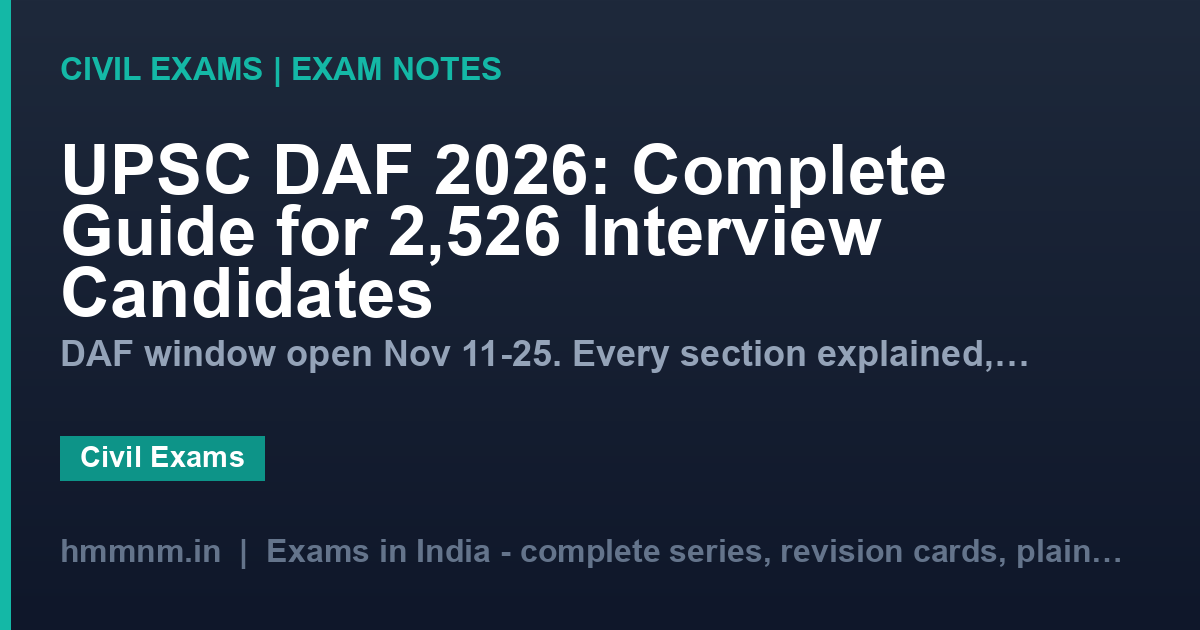
The UPSC CSE Mains 2026 DAF (Detailed Application Form) is mandatory for all 2,526 candidates who qualified for the personality test. Submit on upsc.gov.in between November 11–25, 2026, till 6:00 PM. This guide walks through each section, common mistakes, and what to prepare for the interview based on your DAF.
- Quick Answer
- What the DAF is and why it matters
- Section-by-section guide
- 1. Personal details
- 2. Educational qualifications
- 3. Parental information
- 4. Employment history (if any)
- 5. Hobbies and interests
- 6. Service preference
- 7. Awards, scholarships, positions held
- Common mistakes to avoid
- After submitting the DAF
- Exam angle
- FAQ
- Related reading
What the DAF is and why it matters
The DAF is not paperwork — it is the interview blueprint. The UPSC panel reads it before you walk in, and 60–70% of interview questions trace back to what you write in it: your hobbies, optional subject, home state, service preference, and employment history. A well-thought DAF controls the interview conversation; a careless one surrenders it.
Section-by-section guide
1. Personal details
Name, date of birth, father’s/mother’s name, address, contact — straightforward but verify every spelling against your certificates. A mismatch here becomes a document-verification problem later.
2. Educational qualifications
List every degree from 10th onwards with year, institution, and percentage. Key decisions:
- Optional subject: Must match your Mains optional — no changes allowed now.
- Medium of interview: Choose the language you can speak fluently under pressure — Hindi, English, or a regional language. The interview tests thought, not language choice.
3. Parental information
Father’s and mother’s name, occupation, and income. Be accurate — questions like “Your father is a farmer; what do you know about the PM-Kisan scheme?” are common DAF-derived questions.
4. Employment history (if any)
Job changes, gaps, and career shifts are all fair game. “Why did you leave your job?” and “How does your work experience help you as an administrator?” are classics. Prepare a positive, forward-looking answer — never complain about a past employer.
5. Hobbies and interests
The most interviewed section. Write only what you can sustain 10 minutes of conversation on. “Reading” without naming three books you genuinely engaged with is a trap. “Cricket” without knowing the current Ranji Trophy format is a red flag. Specific beats generic: “Trekking in the Western Ghats” invites better questions than “travelling.”
6. Service preference
IAS → IPS → IFS → IRS (and so on). Order matters — be honest about your reasoning. “Why IAS over IFS?” is asked to those who put IAS first. Have a clear, personal answer that doesn’t dismiss other services.
7. Awards, scholarships, positions held
Include everything verifiable from school onwards. NCC, NSS, college societies, sports — these shape questions about leadership and teamwork. Only list what appears on certificates you can produce.
Common mistakes to avoid
- Vague hobbies — “listening to music, watching movies” invites no good conversation. Replace with “Hindustani classical vocal (learning for 4 years)” if true.
- Copying someone else’s DAF — the panel smells it immediately. Write in your own voice.
- Leaving employment gaps unexplained — a two-year gap will be asked about; have a brief, honest answer.
- Wrong service-preference logic — “IAS because of power” is a wrong answer at every level. Frame it around the work you want to do.
- Missing the deadline — November 25, 6:00 PM. No extensions. Submit by November 20 to leave buffer for corrections.
After submitting the DAF
The e-summon letter (interview call) follows within weeks. Meanwhile, start interview prep: record yourself answering “tell me about yourself” in 2 minutes, prepare your DAF for questioning, and read current affairs daily — the panel asks about events from the week of your interview.
Exam angle
How exams use this: The DAF is not a test — but the interview it shapes carries 275 marks (enough to jump 50+ ranks). Your accuracy in self-presentation matters as much as your Mains score. Prepare for the interview by testing your current-affairs and subject knowledge under timed conditions.
FAQ
Can I edit the DAF after submitting? The window allows limited edits before the deadline. After November 25, no changes are possible.
What if I make a mistake? Email UPSC immediately with your application number. Minor typos in addresses are usually corrected at document verification.
How many copies of the DAF should I carry to the interview? At least 3 printed copies plus one digital copy — the panel, the psychologist (in CPST-style boards), and the chair may each ask for one.
Related reading
- Socio-Religious Reform Movements in 19th Century India: Brahmo Samaj to Aligarh Movement (UPSC Notes)
- Land Revenue Systems in British India: Permanent Settlement, Ryotwari and Mahalwari Compared for UPSC
Quick revision
- Optional subject: Must match your Mains optional — no changes allowed now.
- Medium of interview: Choose the language you can speak fluently under pressure — Hindi, English, or a regional language. The interview tests thought, not language choice.
- Vague hobbies: — “listening to music, watching movies” invites no good conversation.
- Copying someone else’s DAF: — the panel smells it immediately. Write in your own voice.
- Leaving employment gaps unexplained: — a two-year gap will be asked about; have a brief, honest answer.
- Wrong service-preference logic: — “IAS because of power” is a wrong answer at every level. Frame it around the work you want to do.
Have a doubt on this topic?