Quick Answer: What This Environment Quiz Covers
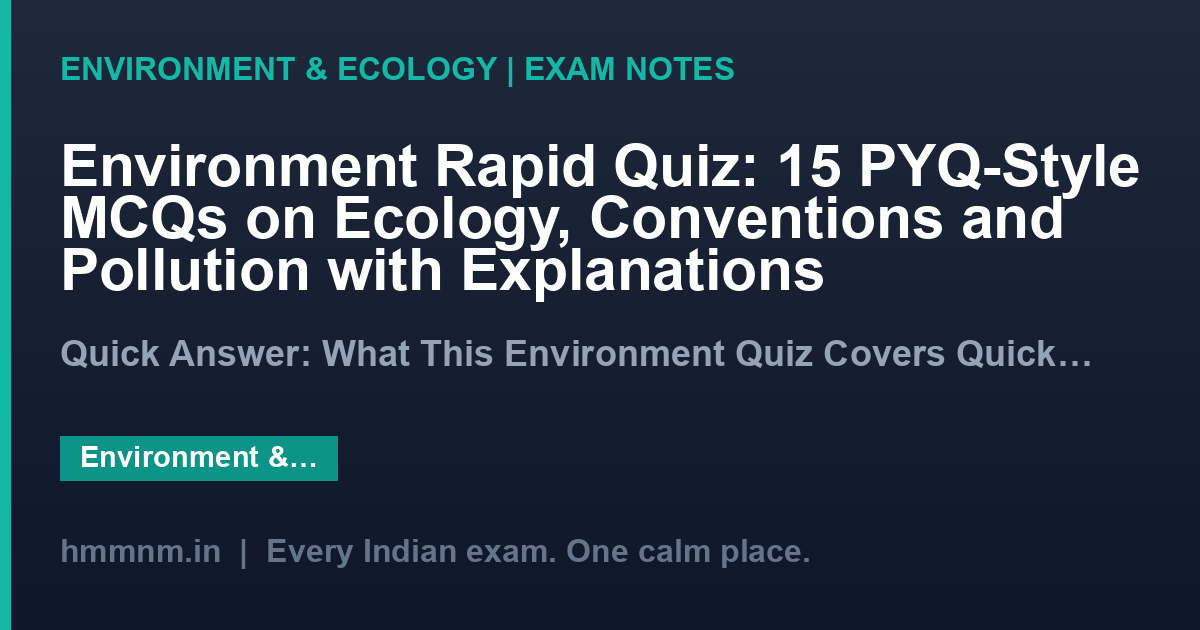
Environment Rapid Quiz: 15 PYQ MCQs on Ecology, Conventions and Pollution
Quick Answer: This rapid quiz gives you 15 PYQ-style environment MCQs for UPSC, SSC and Banking practice, covering ecology and biodiversity basics, national parks and conservation programmes, international climate conventions, Indian pollution control laws and current affairs-linked questions. Every question carries a verified answer key with a plain-English explanation, so you learn the exact fact — not just the correct option. Attempt all 15 in about 12 minutes, then use the score bands to decide your next revision step.
- Quick Answer: What This Environment Quiz Covers
- Why Environment Questions Matter in UPSC, SSC and Banking Exams
- Quiz Instructions and Exam Pattern
- MCQs 1–5: Ecology and Biodiversity Basics
- MCQs 6–8: National Parks, Sanctuaries and Conservation Programmes
- MCQs 9–11: Climate Conventions and Protocols
- MCQs 12–13: Pollution Control Laws and Bodies
- MCQs 14–15: Current Affairs Linked Environment Questions
- Detailed Answer Key with Explanations
- Score Analysis: What Your Result Means
- Key Revision Points: Conventions, Acts and Species in One Table
- Related Quizzes and Free Resources
- Frequently Asked Questions
- Q: How many environment questions appear in UPSC Prelims every year?
- Q: What is the Ramsar Convention and which Indian sites are famous?
- Q: Which is the best source for environment MCQ practice?
- Q: What is the difference between the Kyoto Protocol and the Paris Agreement?
- Q: What role does the NGT play in pollution control in India?
- Related reading
Why Environment Questions Matter in UPSC, SSC and Banking Exams
Environment and ecology has become a high-weightage segment after 2011, when UPSC revamped its Prelims pattern. Typically 10–20 questions combine environment and geography each year, and several environment questions overlap with current affairs — a Ramsar site addition, a COP summit outcome or a new tiger reserve can appear directly in the paper.
For SSC CGL and Banking exams, environment questions are usually simpler and fact-based: conventions and their years, pollution-control bodies, national parks and recent government schemes. That makes this section one of the fastest-scoring areas if you prepare from PYQs and a good current affairs digest.
- UPSC Prelims: Analytical ecology questions — food chains, pyramids, species behaviour — plus convention-linked current affairs.
- SSC CGL/CHSL: Direct facts — Ramsar sites, Project Tiger, Acts and their years.
- Banking (IBPS/SBI): Static GK plus recent environment news in the General Awareness section.
Quiz Instructions and Exam Pattern
- Total questions: 15 MCQs, 1 mark each.
- Suggested time: 12 minutes — roughly 45 seconds per question, matching Prelims pace.
- Negative marking: For UPSC practice, deduct 0.66 marks for each wrong answer; for SSC/Banking practice, deduct 0.25 marks.
- Attempt all questions before scrolling to the answer key — honest self-testing is the whole point.
MCQs 1–5: Ecology and Biodiversity Basics
Q1. In a grassland ecosystem, the correct sequence of a food chain is:
(a) Grass → Hawk → Snake → Frog → Grasshopper (b) Grass → Grasshopper → Frog → Snake → Hawk (c) Grass → Frog → Grasshopper → Hawk → Snake (d) Hawk → Snake → Frog → Grasshopper → Grass
Q2. Which ecological pyramid is always upright in shape, in every ecosystem?
(a) Pyramid of number (b) Pyramid of biomass (c) Pyramid of energy (d) Pyramid of biomass in a lake
Q3. A species whose impact on its ecosystem is disproportionately large relative to its abundance is called a:
(a) Indicator species (b) Keystone species (c) Endemic species (d) Umbrella species
Q4. Which of the following is NOT a criterion for identifying a biodiversity hotspot?
(a) High species endemism (b) Habitat loss of over 70% (c) At least 1,500 endemic vascular plant species (d) Presence of a UNESCO biosphere reserve tag
Q5. The Western Ghats are considered a biodiversity hotspot primarily because of:
(a) Large area under agriculture (b) Exceptional endemism and habitat threat (c) Highest number of tigers in India (d) Presence of the largest mangrove forest
MCQs 6–8: National Parks, Sanctuaries and Conservation Programmes
Q6. Project Tiger was launched in:
(a) 1972 (b) 1973 (c) 1986 (d) 1992
Q7. Which of the following is a UNESCO-recognised Biosphere Reserve of India?
(a) Chilika (b) Nilgiri (c) Bharatpur (d) Dachigam
Q8. Under the Ramsar Convention, a wetland is designated as a Ramsar site based on:
(a) Its religious importance (b) International significance for waterfowl habitat (c) Its use for irrigation only (d) Being located inside a national park
MCQs 9–11: Climate Conventions and Protocols
Q9. The UNFCCC was adopted at the Earth Summit held in:
(a) Kyoto, 1997 (b) Rio de Janeiro, 1992 (c) Paris, 2015 (d) Stockholm, 1972
Q10. Which agreement aims to limit global warming to well below 2°C, pursuing efforts towards 1.5°C?
(a) Kyoto Protocol (b) Montreal Protocol (c) Paris Agreement (d) Copenhagen Accord
Q11. The Montreal Protocol (1987) deals with:
(a) Greenhouse gas reduction targets (b) Protection of the ozone layer (c) Wetland conservation (d) Biodiversity conservation
MCQs 12–13: Pollution Control Laws and Bodies
Q12. The National Green Tribunal (NGT) was established under:
(a) The Environment (Protection) Act, 1986 (b) The NGT Act, 2010 (c) The Water Act, 1974 (d) The Air Act, 1981
Q13. The Central Pollution Control Board (CPCB) was first constituted under which Act?
(a) Air (Prevention and Control of Pollution) Act, 1981 (b) Environment (Protection) Act, 1986 (c) Water (Prevention and Control of Pollution) Act, 1974 (d) National Green Tribunal Act, 2010
MCQs 14–15: Current Affairs Linked Environment Questions
Q14. India’s total Ramsar wetland count has crossed which milestone, making it one of the largest networks in Asia?
(a) 64 sites (b) 75 sites (c) 85 sites (d) 91 sites
(Note: Ramsar site counts change with each COP cycle — always cross-check the latest figure on ramsar.org or pib.gov.in before your exam.)
Q15. India’s updated climate commitments (NDCs) under the Paris Agreement include achieving about how much of installed electric capacity from non-fossil fuel sources by 2030?
(a) 40% (b) 50% (c) 60% (d) 75%
Detailed Answer Key with Explanations
- Q1 — (b). Grass → Grasshopper → Frog → Snake → Hawk. Producers (grass) come first, followed by primary consumers and successive predators. This is a classic PYQ-level food chain question.
- Q2 — (c). The pyramid of energy is always upright because energy is lost at each trophic level (10% law). Pyramids of number and biomass can be inverted (e.g., tree-based number pyramids; lake biomass pyramids).
- Q3 — (b). Keystone species — e.g., the sea otter in kelp ecosystems — have an outsized ecological effect relative to their numbers.
- Q4 — (d). A UNESCO biosphere reserve tag is not a hotspot criterion. Hotspots need at least 1,500 endemic vascular plant species and 70%+ habitat loss. India has four biodiversity hotspots: the Himalayas, Western Ghats–Sri Lanka, Indo-Burma and Sundaland.
- Q5 — (b). The Western Ghats qualify due to exceptional plant endemism combined with severe habitat threat.
- Q6 — (b). Project Tiger launched in 1973 from Jim Corbett National Park. (The Wildlife Protection Act was 1972 — a common trap option.)
- Q7 — (b). The Nilgiri Biosphere Reserve (1986) was India’s first and is part of UNESCO’s Man and Biosphere (MAB) network.
- Q8 — (b). Ramsar designation rests on international significance, particularly as waterfowl habitat, under the criteria of the 1971 Ramsar Convention.
- Q9 — (b). The UNFCCC was adopted at the Rio Earth Summit, 1992; it entered into force in 1994. Kyoto (1997) set binding targets on developed countries.
- Q10 — (c). The Paris Agreement (2015, effective 2016) set the “well below 2°C, pursue 1.5°C” goal and works through voluntary NDCs.
- Q11 — (b). The Montreal Protocol phases out ozone-depleting substances; its Kigali Amendment (2016) addresses HFCs, a frequent current-affairs angle.
- Q12 — (b). NGT is a statutory body under the NGT Act, 2010, mandated to dispose of environmental cases within six months of filing.
- Q13 — (c). The CPCB was first constituted under the Water Act, 1974; it later received powers under the Air Act, 1981 and the Environment (Protection) Act, 1986.
- Q14 — (c). India’s Ramsar network crossed 85 sites, among the largest in Asia. Verify the exact current number before your exam, as designations continue.
- Q15 — (b). India’s updated NDC (2022) targets about 50% of cumulative electric power installed capacity from non-fossil fuel sources by 2030, alongside the net-zero-by-2070 pledge announced at COP26 Glasgow.
Score Analysis: What Your Result Means
- 13–15: Exam-ready. Move to full-length mocks and current affairs digests only.
- 10–12: Strong base. Revise conventions and Acts using the table below; your losses are likely in fact-recall.
- 6–9: Revisit NCERT Biology (Classes 11–12) and Shankar/standard environment notes chapter by chapter, then re-attempt.
- Below 6: Start from NCERT Class 12 Ecology chapters and PYQs; build foundations before attempting timed quizzes.
Key Revision Points: Conventions, Acts and Species in One Table
| Convention / Law / Body | Year | Key Fact |
|---|---|---|
| Stockholm Conference | 1972 | First UN environment conference; UNEP born |
| Ramsar Convention | 1971 | Wetland conservation; India’s famous sites: Chilika, Sundarbans, Keoladeo |
| Water Act | 1974 | CPCB constituted; water pollution control |
| Air Act | 1981 | Air pollution control; CPCB empowered |
| Montreal Protocol | 1987 | Ozone layer protection; Kigali Amendment 2016 (HFCs) |
| Environment (Protection) Act | 1986 | Umbrella legislation post-Bhopal disaster |
| UNFCCC | 1992 | Rio Earth Summit; framework for climate talks |
| Kyoto Protocol | 1997 | Binding targets for developed nations |
| Paris Agreement | 2015 | Well below 2°C; voluntary NDCs by all countries |
| NGT Act | 2010 | Statutory tribunal; six-month disposal mandate |
Related Quizzes and Free Resources
For full-spectrum practice, pair this quiz with our polity, economy and science mock sets. Authoritative sources worth bookmarking: PIB for environment schemes and Ramsar announcements, MoEFCC for laws and programmes, UNFCCC for COP documents, and ramsar.org for the official sites list.
Frequently Asked Questions
Q: How many environment questions appear in UPSC Prelims every year?
Typically 10–20 questions combine environment and geography, though the trend varies year to year. Some papers lean heavily on ecology concepts; others mix in convention-linked current affairs, so prepare both static and dynamic content.
Q: What is the Ramsar Convention and which Indian sites are famous?
The Ramsar Convention (1971, Ramsar, Iran) is an intergovernmental treaty for the conservation and wise use of wetlands. India’s most famous Ramsar sites include Chilika Lake (Odisha) and Keoladeo National Park (Rajasthan) — India’s first two, designated in 1981 — plus the Sundarbans Wetland, Loktak Lake and Wular Lake.
Q: Which is the best source for environment MCQ practice?
NCERT Biology (Classes 11–12) for concepts, PYQs from UPSC and SSC papers for pattern and difficulty, and monthly current affairs compilations for Ramsar additions, COP outcomes and new protected areas. Cross-check announcements on PIB.
Q: What is the difference between the Kyoto Protocol and the Paris Agreement?
Kyoto (1997) imposed binding emission-reduction targets only on developed nations. The Paris Agreement (2015) moved to a bottom-up model where all countries set voluntary NDCs, with the collective goal of limiting warming well below 2°C.
Q: What role does the NGT play in pollution control in India?
The NGT is a statutory body under the NGT Act, 2010, set up for fast disposal of environmental cases — with a mandate to conclude cases within six months. It can award compensation for environmental damage and order closure of polluting units.
Related reading
- National Parks vs Wildlife Sanctuaries vs Tiger Reserves: Legal Backing and Buffer Zone Rules Explained
- Wetlands of India: Ramsar Sites, Montreux Record & State-Wise Count for UPSC & SSC
Quick revision
- UPSC Prelims: Analytical ecology questions — food chains, pyramids, species behaviour — plus convention-linked current affairs.
- SSC CGL/CHSL: Direct facts — Ramsar sites, Project Tiger, Acts and their years.
- Banking (IBPS/SBI): Static GK plus recent environment news in the General Awareness section.
- Total questions: 15 MCQs, 1 mark each.
- Suggested time: 12 minutes — roughly 45 seconds per question, matching Prelims pace.
- Negative marking: For UPSC practice, deduct 0.66 marks for each wrong answer; for SSC/Banking practice, deduct 0.25 marks.
Have a doubt on this topic?