Balance of Payments Explained: Current and Capital Accounts Simplified
Balance of payments questions run through every cycle because the account binds trade, capital and reserves into one arithmetic frame. This one-pager fixes the two accounts, their standard items, the financing identity and the exam traps around surplus and deficit. Therefore, read the table first, then the notes, then the drill.
- The Account Map
- Current-Account Items
- The CAD Story
- Capital-Account Items
- Five-Question Drill
- FAQ
- Is a CAD always bad?
- Where do reserves sit?
- The Thirty-Second Recap
- Explain It Simply
- Rapid-Fire
- Abbreviations
- The Rupee Connects the Accounts
- The One-Paragraph Mains Skeleton
- The Reserves Story in One Paragraph
- The Errors-and-Omissions Note
- The Thresholds Table
- A Closing Walk Through the Ledger
- Ten-Question Sprint
- The Worked Statement Pair
- The Account in the Headline Mirror
- The Final Word
- Key Takeaways
- The Block by Numbers
- The Framework Line
- The Closing Paragraph
- The Acronym Echo
- Twelve Numbers That Carry the Account
- Related reading
Contents: the account map, current-account items, capital-account items, the financing identity, CAD dynamics, drill and mains framing.
The Account Map
| Account | Standard Items | Exam Hook |
|---|---|---|
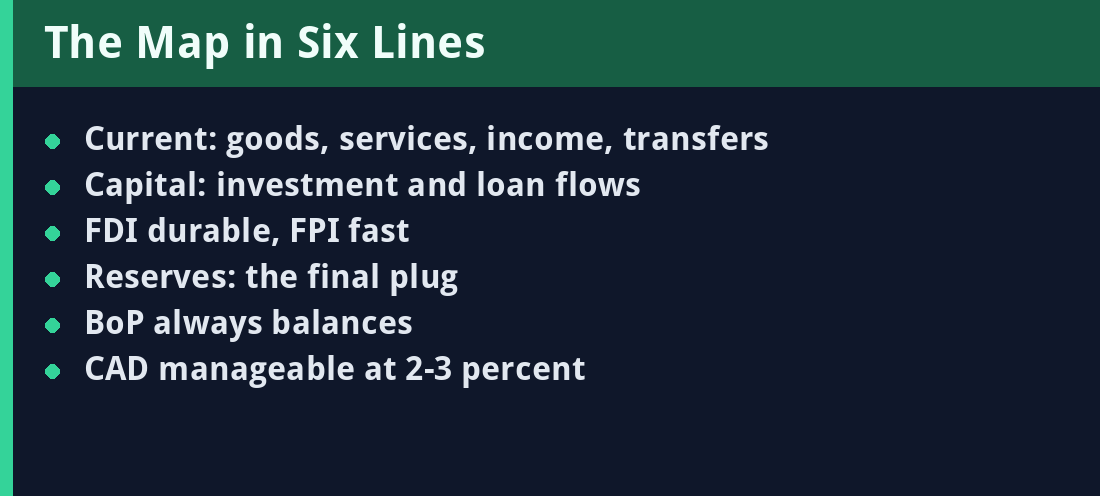
| Current | Goods, services, income, transfers | Trade plus invisibles |
| Capital | Foreign investment flows, loans, banking | Change in liabilities |
| Errors and omissions | Statistical residual | The balancing fudge |
| Reserve financing | RBI reserve movement | The final plug |
Moreover, the double-entry frame always balances, therefore a “deficit” means the current account alone, financed by net capital inflows or reserve drawdowns. Consequently, statement questions that call the whole account unbalanced are traps by construction.
Current-Account Items
- Goods: the merchandise trade balance, customs-measured.
- Services: software exports, travel and transport dominate India’s surplus lane.
- Income: interest, profits and dividends flowing abroad on past investments.
- Transfers: remittances from workers abroad, India’s steady cushion.
The CAD Story
India’s current-account deficit widens with crude rallies and gold imports, however services and remittances cushion the gap. Moreover, a deficit near two to three percent of GDP reads manageable, while crisis episodes crossed four. Therefore, mains answers pair the deficit number with its financing quality – stable flows versus hot money – because sustainability lives in the mix, not the headline.
Capital-Account Items
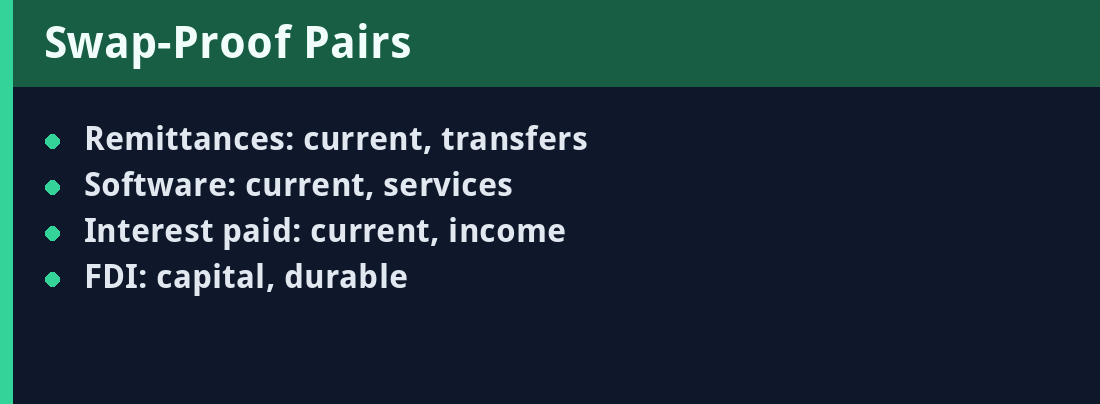
- Foreign direct investment: durable, plant-and-equity stakes.
- Portfolio flows: market-traded, faster out the door.
- External loans: commercial and sovereign borrowing lines.
- Banking flows: NRI deposit swings round the account.
However, examiners swap FDI with portfolio in statement sets, therefore anchor durability against speed. In addition, the capital account records liability changes while the current records flows of income and goods – the cleanest one-line distinction the paper rewards.
BOP always balances; only its components learn to blush.
Five-Question Drill
- Remittances sit in: the answer is the current account, under transfers.
- Software exports enter: the answer is services, current account.
- The BOP always balances because: the answer is double-entry with reserve financing.
- The more durable inflow: the answer is FDI over portfolio.
- Crisis-level CAD readings crossed: the answer is four percent of GDP.

FAQ
Is a CAD always bad?
No; financed by stable inflows for productive use, a moderate deficit funds growth.
Where do reserves sit?
The Thirty-Second Recap
Two main accounts. Therefore, current earns and spends. Capital borrows and invests. Moreover, goods trade visibly. Services and transfers cushion. However, FDI stays. Portfolio flees. Reserves plug the gap. Finally, the whole book balances. Only faces change. Say it. Bank it.
Explain It Simply
Think of the country as a household with two notebooks. The first notebook writes today’s earnings and spends – selling tea, earning tips from abroad, paying interest on old loans. The second writes who put money into the house – a neighbour buying a room outright, or a visitor lending cash overnight. However, the two notebooks must tie at year end, and the family’s emergency jar makes the last entry. Therefore, when papers say the household runs a deficit, they mean only the first notebook, and the second notebook plus the jar explain exactly how it was paid.
Rapid-Fire
- Accounts: current and capital.
- Current: goods, services, income, transfers.
- Cushions: services surplus and remittances.
- Durable inflow: FDI.
- Flighty inflow: portfolio.
- Final plug: reserves.
- Manageable CAD: 2-3 percent of GDP.
- Crisis line: above 4 percent.
Abbreviations
- BOP: balance of payments.
- CAD: current-account deficit.
- FDI: foreign direct investment.
- FPI: foreign portfolio investment.
- RBI: the reserve manager.
- NRI: the deposit swing lane.
The Rupee Connects the Accounts
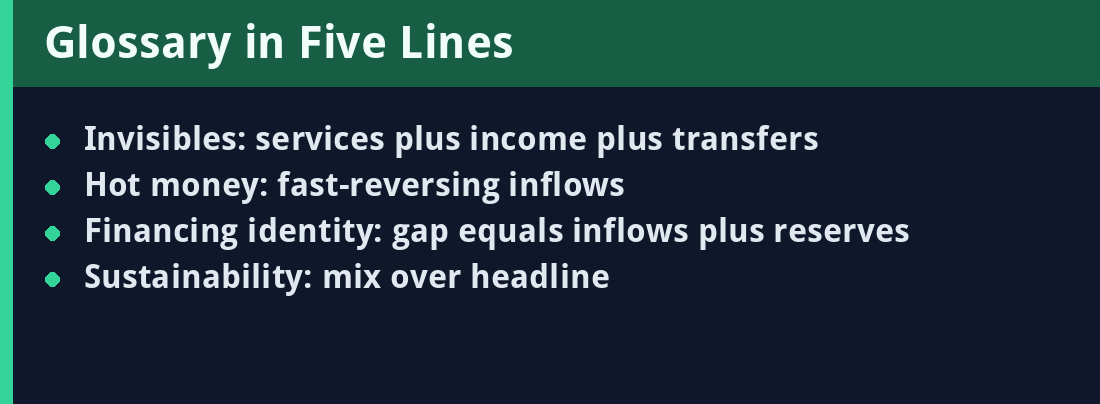
Moreover, the external account’s story lands home through the rupee, and the connective tissue earns mains marks. A wider current-account deficit pressures the currency, therefore the reserve manager leans against disorderly moves, and the financing mix decides how hard it must lean. However, stable inflows cushion the pass-through, while hot money amplifies it, which is why the quality of financing appears in every policy comment. Consequently, one paragraph linking trade gap, financing mix, reserve movement and the rupee reads like an economist’s summary, and it costs you exactly the four lines this page just taught.
Furthermore, examiners pair BOP with the WPI-CPI page and the toolkit page from this site’s economy series, because inflation, rates and the external account move together. Therefore, revise the three pages in one sitting, and the mains answer that cites all three reads as synthesis rather than recall.
The One-Paragraph Mains Skeleton
Finally, memorise the skeleton: define the two accounts, state the cushions, name the financing identity, cite the threshold bands, and close with the sustainability point. Therefore, five sentences carry the entire block, and the skeleton generalises to every economy topic this series covers.
The Reserves Story in One Paragraph
Moreover, reserves deserve their own paragraph because they absorb the identity’s final leg. Import cover, measured in months of merchandise imports, reads healthiest when comfortable; currency movements revalue the stock; and gold’s share sways with prices. However, reserves are a stock while flows fill the accounts, therefore mains answers that distinguish stock from flow read like economics rather than journalism. Consequently, one sentence – reserves are the balance the flows leave behind – carries the entire nuance.
The Errors-and-Omissions Note
Furthermore, the statistical residual exists because measurement lags and under-reporting leave gaps, and honest answers name it rather than hide it. Therefore, when mains asks why accounts never tie exactly, the residual is the two-mark answer, wearing its modest technical name.
The Thresholds Table
| Marker | Reading |
|---|---|
| Comfortable CAD | 2-3 percent of GDP |
| Crisis zone | Above 4 percent |
| Reserve metric | Months of import cover |
| Identity | Current plus capital plus reserves equals zero |
A Closing Walk Through the Ledger
Finally, close the page by walking the ledger once, in order. Goods leave and arrive, customs counting both. Services bill outward, software leading. Income pays old investors their dues. Transfers bring the diaspora’s remittances home. Below the line, investors buy rooms outright or lend overnight, and the reserve jar makes the books tie. Therefore, one walk, five shelves, two notebooks and a jar – and the external sector stops being a diagram and becomes a household you know. Moreover, the economy series continues tomorrow with the monetary toolkit’s cousin pages, and the accounts now stand ready to receive them.
Ten-Question Sprint
- Current-account items: goods, services, income, transfers – the answer is all four.
- Remittances sit under: the answer is transfers.
- Software exports sit under: the answer is services.
- Interest paid abroad sits under: the answer is income.
- Durable inflow: the answer is FDI.
- Flighty inflow: the answer is portfolio investment.
- The final balancing item: the answer is reserve movement.
- Comfortable CAD band: the answer is 2-3 percent.
- Crisis line: the answer is above 4 percent.
- BOP always: the answer is balances, by double entry.
The Worked Statement Pair
Moreover, attempt these two as mains practice tonight. Statement one: a current-account deficit implies the country is bankrupt – false, because financing quality decides sustainability. Statement two: reserves are a flow item – false, because reserves are the stock the flows leave behind. Therefore, each false carries its one-line repair, and repaired falses are the format’s entire grammar. In addition, the thresholds table above converts into two more statements whenever the paper wants numbers instead of concepts.
The Account in the Headline Mirror
Moreover, external-sector headlines land differently once the map is internalised. A crude rally headline becomes a current-account pressure line; an FPI inflow headline becomes a financing-quality line; a reserve build-up headline becomes the jar’s arithmetic line. Therefore, the page converts three weekly headlines into one paragraph you already own, and mains asks for nothing more than that conversion performed calmly. However, the trap stays the same in every cycle: calling the deficit a bankruptcy, and the repair line – financing quality decides sustainability – answers it in one stroke.
Furthermore, the series’ economy chain now runs six pages long: inflation’s two thermometers, the toolkit, the deficit family, the accounts, the growth print and the trade story, and the chain composes into a complete mains answer about macro management. Consequently, one connected evening this week, walking all six in order, may be the single highest-yield hour the economy syllabus offers.
The Final Word
Therefore, keep the two notebooks and the jar in one mental shelf, and every external headline files itself on arrival – which is the entire discipline this page teaches.
Key Takeaways
In conclusion, hold the two-account map, the item lists, and the financing identity with reserves as the plug. To summarize, durability beats speed, cushions beat headlines. Therefore, revise the table twice this week, drill once, and the external sector banks itself.
References: the RBI’s balance-of-payments statistics and monthly bulletins.
The Block by Numbers
- Accounts: 2 primary, plus errors and reserves.
- Current items: 4 – goods, services, income, transfers.
- Comfortable CAD: 2 to 3 percent of GDP.
- Crisis line: above 4 percent.
- Import-cover comfort: 8 to 12 months by recent practice.
- Chokepoint inflows: FPI, the fast lane.
- The BOP, RBI, FDI, FPI, CAD and NRI set recurs in every paper.
The Framework Line
Moreover, the account runs as a protocol: each flow is validated by double entry, financing is authorised by inflows or reserves, and compliance with the identity is non-negotiable – the framework never fails to balance, only to flatter.
The Closing Paragraph
Moreover, the balance of payments rewards candidates who narrate rather than list, because narration carries the identity the lists only imply. Therefore, when the RBI, the FDI desk, the portfolio lane and the reserve jar all appear in one question, connect them in the order the money moves, and the answer writes itself along the chain. However, the chain only flows when each item keeps its account label, therefore rehearse the labelling until it survives pressure. In addition, the NRI deposit lane and the errors-and-omissions residual complete the cast, and naming both signals genuine command of the BOP, CAD and FPI vocabulary that papers test every cycle.
The Acronym Echo
- The BOP, RBI, FDI, FPI, CAD and NRI set owns this page, with the WTO and IMF waiting in mains follow-ups.
- Moreover, the NSO publishes the trade data that feeds the BOP’s goods line every month.
Twelve Numbers That Carry the Account
- Accounts: 2 primary; current items: 4.
- Comfortable CAD: 2 to 3 percent; crisis line: above 4.
- Reserve comfort: 8 to 12 months of import cover.
- Growth print this cycle: 7.8 percent, Q1 FY27.
- Repo held at 5.25 percent; target 4 in a 2 to 6 band.
- Glide floor for the deficit: 4.5 percent of GDP.
- Ramsar register: 80-plus; assembly session: 81st.
- Revise day 1, day 3, day 7 – the 3-date protocol.
Related reading
- Balance of Payments Explained: Current Account, Capital Account and BoP Crisis Lessons for UPSC
- Inflation Demystified: WPI vs CPI, Base Effects and the MPC's 4% Target for RBI Grade B & UPSC
Quick revision
- Goods: the merchandise trade balance, customs-measured.
- Services: software exports, travel and transport dominate India’s surplus lane.
- Income: interest, profits and dividends flowing abroad on past investments.
- Transfers: remittances from workers abroad, India’s steady cushion.
- Foreign direct investment: durable, plant-and-equity stakes.
- Portfolio flows: market-traded, faster out the door.
Have a doubt on this topic?