UPSC Prelims Parliament Mock Test: 25 Solved MCQs
Parliament is the highest-yield polity topic in the UPSC Prelims, contributing questions in almost every cycle of the last decade. Therefore, this full-length practice set mirrors the prelims register: 25 questions, four options each, negative marking of one-third, and a strict 30-minute timer. Attempt honestly before reading the key.
- Question Paper: 25 Questions, 30 Minutes
- Answer Key
- Explanations That Matter
- Committee Compositions on One Screen
- Common Traps and Distractors
- The Numbers Game
- House-Exclusive Powers
- How to Revise This Block
- FAQ
- Is Laxmikanth enough for this topic?
- What score should I target here?
- Legislative Procedure in Depth
- Stages of an Ordinary Bill
- How the Budget Passes
- Privileges and Delegated Legislation
- Why This Set Predicts Prelims Performance
- One Habit for the Final Week
- In Short: The Plain-English Summary
- Glossary in Five Lines
- The Thirty-Second Recap
- Explain It Simply: Parliament for a Twelve-Year-Old
- Parliament Rapid-Fire: Ten Answers in Ten Lines
- Abbreviations That Recur in Parliament Questions
- Key Takeaways
Balance of Payments and the Rupee: India's Two-Way Ledger
Environment Part 9: The 500 GW Push — Solar, Wind and Storage
Contents: question paper, answer key with one-line explanations, committee composition table, common traps, and a revision strategy for the parliamentary procedure block of Laxmikanth.
Question Paper: 25 Questions, 30 Minutes
- After the 104th Amendment, the maximum elective strength of the Lok Sabha is: (a) 540, (b) 550, (c) 552, (d) 560
- The Rajya Sabha can have a maximum of: (a) 238 elected members, (b) 250 members total, (c) 245 members, (d) 252 members
- Who certifies a Money Bill? (a) President, (b) Finance Minister, (c) Speaker, (d) Attorney General
- Under Article 249, the Rajya Sabha can legislate on a state subject with: (a) simple majority, (b) two-thirds majority present and voting, (c) absolute majority, (d) joint sitting approval
- A no-confidence motion requires the support of at least: (a) 25 members, (b) 50 members, (c) 100 members, (d) one-tenth of members
- The quorum to constitute a sitting of either House is: (a) one-tenth of total membership, (b) one-third, (c) 100 members, (d) one-fifth
- Zero Hour in the Indian Parliament is: (a) a constitutional provision, (b) a procedural convention, (c) a Standing Committee meeting, (d) a joint sitting clause
- The Estimates Committee consists of: (a) 22 members, (b) 30 members, (c) 15 members, (d) 45 members
- The Public Accounts Committee has: (a) 15 members, (b) 22 members including 7 from Rajya Sabha, (c) 30 members, (d) 12 members
- By convention since 1967, the PAC is chaired by: (a) a ruling party member, (b) a opposition member, (c) the Speaker, (d) the Finance Minister
- Joint sitting under Article 108 is not permitted for: (a) ordinary bills, (b) Money Bills, (c) bills returned by the President, (d) financial bills other than Money Bills
- The President’s address to both Houses at the first session each year is mandated by: (a) Article 85, (b) Article 87, (c) Article 108, (d) Article 112
- Appropriation Bills authorize: (a) taxation, (b) expenditure from the Consolidated Fund, (c) borrowing, (d) disinvestment
- Adjournment motion is available: (a) in both Houses, (b) only in Lok Sabha, (c) only in Rajya Sabha, (d) in committee meetings
- A Money Bill returned by the Rajya Sabha must be acted on by the Lok Sabha within: (a) 7 days, (b) 14 days, (c) 30 days, (d) 6 months
- The Speaker addresses a resignation to: (a) the President, (b) the Prime Minister, (c) the Deputy Speaker, (d) the House Secretary
- The first Speaker of the Lok Sabha was: (a) Mavalankar, (b) Radhakrishnan, (c) Hidayatullah, (d) Santhanam
- The maximum permissible gap between two parliamentary sessions is: (a) 3 months, (b) 4 months, (c) 6 months, (d) 12 months
- A starred question is one that receives: (a) a written answer, (b) an oral answer with supplementaries, (c) a deferred answer, (d) a committee reference
- The Committee on Public Undertakings was created on the recommendation of: (a) Krishna Menon Committee, (b) Ashok Chandra Committee, (c) Gorwala Report, (d) Appleby Report
- A token cut motion reduces a demand by: (a) one rupee, (b) one hundred rupees, (c) a specified amount, (d) five hundred rupees
- The ex-officio Chairman of the Rajya Sabha is: (a) the President, (b) the Vice President, (c) the Speaker, (d) the Leader of the House
- Prorogation of a House is done by: (a) the Speaker, (b) the President, (c) the Leader of the House, (d) the Cabinet
- A policy cut motion reduces a demand to: (a) one rupee, (b) one hundred rupees, (c) zero, (d) a token amount
- Which House can initiate the removal of the Speaker through a resolution? (a) Rajya Sabha, (b) Lok Sabha, (c) either House, (d) a joint sitting
Answer Key
| Q | Ans | Q | Ans | Q | Ans | Q | Ans | Q | Ans |
|---|---|---|---|---|---|---|---|---|---|
| 1 | b | 2 | b | 3 | c | 4 | b | 5 | b |
| 6 | a | 7 | b | 8 | b | 9 | b | 10 | b |
| 11 | b | 12 | b | 13 | b | 14 | b | 15 | b |
| 16 | c | 17 | a | 18 | c | 19 | b | 20 | a |
| 21 | b | 22 | b | 23 | b | 24 | a | 25 | b |
Explanations That Matter
- Q1: The 104th Amendment ended the two nominated Anglo-Indian seats, therefore the elective ceiling becomes 550.
- Q2: Article 80 fixes 250 as the maximum, with 238 elected plus 12 nominated.
- Q3: Article 110(3) makes the Speaker’s certificate final on Money Bill status.
- Q4: Article 249 needs two-thirds of members present and voting, valid for one year at a time.
- Q5: Fifty members must back the leave to introduce a no-confidence motion.
- Q7: Zero Hour is an Indian innovation by convention, immediately after Question Hour.
- Q8-Q10: Estimates has 30 members all from Lok Sabha; PAC has 22 with an opposition chair since 1967.
- Q11: Joint sitting excludes Money Bills and Constitutional Amendment Bills.
- Q15: The Rajya Sabha gets 14 days to return a Money Bill, under Article 109.
- Q21 and Q24: Policy cut reduces the demand to one rupee; token cut slashes one hundred rupees to voice disapproval.
Committee Compositions on One Screen
| Committee | Strength | Composition |
|---|---|---|
| Public Accounts | 22 | 15 LS + 7 RS, opposition chair |
| Estimates | 30 | All LS, proportional election |
| Public Undertakings | 22 | 15 LS + 7 RS, from 1964 |
| Privileges (LS) | 15 | Nominated by Speaker |
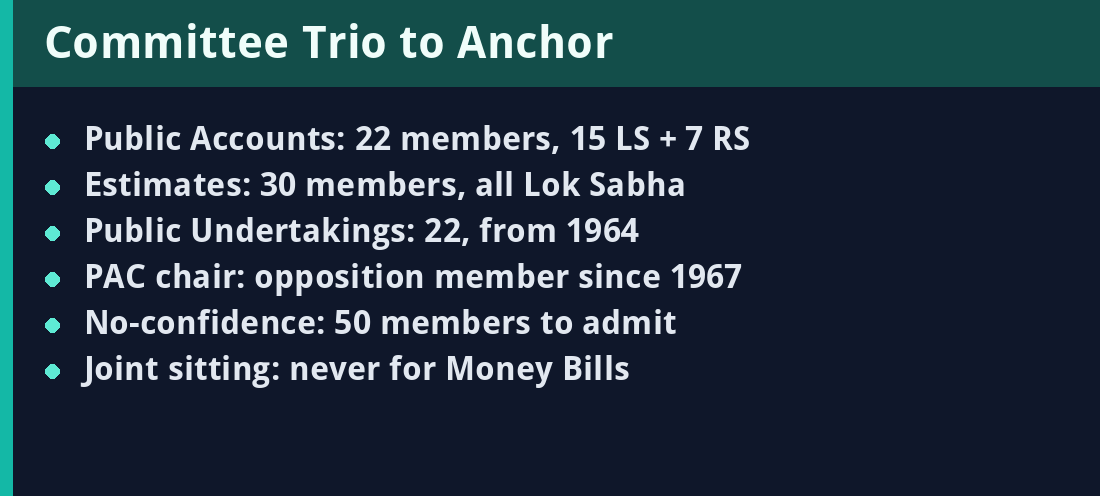
Moreover, examiners swap these compositions deliberately. Therefore, anchor the trio as 22-30-22, and remember only Estimates is unicameral. Meanwhile, the Krishna Menon Committee (1964) recommended the Public Undertakings body, a recurrent prelims fact.
Common Traps and Distractors
The Numbers Game
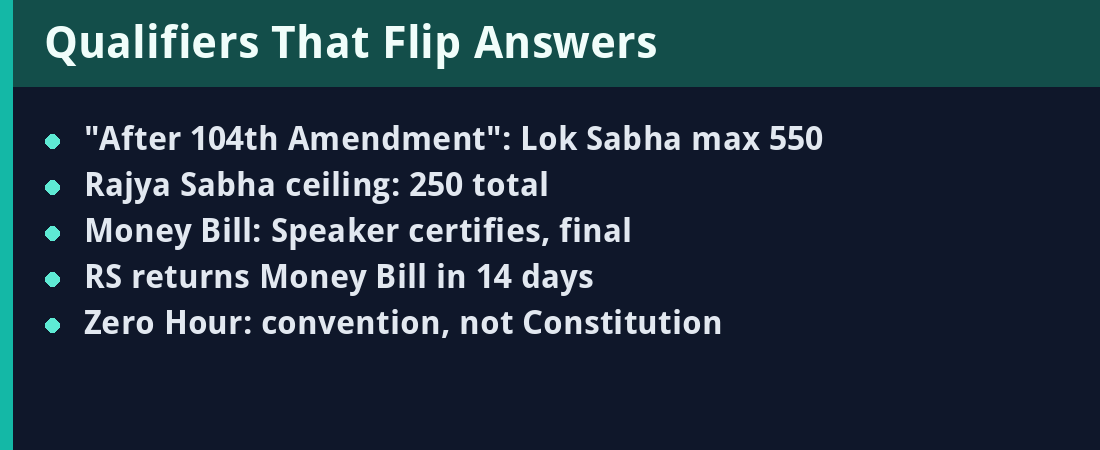
Questions pair 550 against 552, or 238 against 250, because near numbers test precision. Consequently, always read the qualifier: “after the 104th Amendment” changes the answer, while “as originally enacted” restores 552. Similarly, 50 members serves double duty – no-confidence and adjournment – therefore options citing 25 or 100 are bait.
House-Exclusive Powers
- Only Lok Sabha: no-confidence, adjournment motion, Money Bill passage, Estimates Committee.
- Only Rajya Sabha: Article 249 state-list legislation, Article 312 all-India services.
- Neither alone: constitutional amendments need both Houses separately.
Prelims polity is won on qualifiers, not on headlines – one word in the stem flips the key.
How to Revise This Block
Firstly, read the parliamentary chapters twice, then attempt this set under timer. Secondly, log every error into a trap notebook with the qualifier that decided it. Finally, re-attempt after five days, targeting 20 or more correct. Moreover, pair this set with the site’s Fundamental Rights judgement one-pager, because prelims frequently fuse Parliament procedure with rights questions.
FAQ
Is Laxmikanth enough for this topic?
Yes for concept, however previous-year papers add the trap sense this set rehearses.
What score should I target here?
Aim for 20-plus of 25, because Parliament is a core-strength zone where toppers bank marks.
Legislative Procedure in Depth
Stages of an Ordinary Bill
- First reading: introduction and title publication.
- Second reading: general discussion, then committee or clause-by-clause consideration.
- Third reading: voting on the final text by title.
- Transmission to the other House for the same three-stage journey.
- Presidential assent, assent withheld, or return for reconsideration once.
Moreover, a joint sitting becomes available only after the second House rejects, or six months pass without agreement. Therefore, questions sequencing these stages reward a fixed mental checklist. In addition, a bill returned by the President passes with a simple reconsideration vote, not a fresh passage.
How the Budget Passes
- The President causes the Annual Financial Statement to be laid under Article 112.
- General discussion precedes departmental scrutiny by standing committees.
- Voting on Demands for Grants happens only in the Lok Sabha.
- The Appropriation Bill authorises withdrawal from the Consolidated Fund.
- The Finance Bill gives effect to taxation proposals within seventy-five days.
Consequently, the sequence statement-question almost writes itself: discussion, scrutiny, voting, appropriation, finance legislation. Meanwhile, remember that Rajya Sabha discusses but never votes on grants.
Privileges and Delegated Legislation
- Freedom of speech in the House is protected by Article 105.
- Breach of privilege motions go to the privileges committee of each House.
- Subordinate legislation lets executives fill detail under parliamentary law.
- Committees on subordinate legislation review such rule-making annually.
However, privilege questions increasingly test the 44th Amendment context and court dialogues rather than bare definitions. Therefore, revise one leading precedent per privilege topic, and quote it in mains answers for instant authority.
Why This Set Predicts Prelims Performance
Parliament questions behave like a canary for overall polity readiness, because they combine constitutional text, procedural convention and numerical limits in a single paper. Therefore, a candidate scoring twenty here rarely falters elsewhere in polity. Moreover, the reverse also holds: confusion between the Speaker’s and the President’s roles usually signals wider revision gaps, which this set surfaces early. Consequently, treat the score not as a verdict but as a diagnosis pointing to the exact chapter needing a second pass.
One Habit for the Final Week
Spend the final week before prelims rewriting this set’s wrong answers as affirmative statements in a single notebook. For example, a miss on the joint sitting exclusion becomes a line reading that Money Bills and amendment bills alone stay outside Article 108. Therefore, each error converts into a retrievable sentence rather than a scar. Moreover, candidates who maintain this habit report that polity revision compresses to twenty minutes on the exam eve, because the notebook carries only personal evidence. Consequently, the practice set earns its value twice, first as diagnosis and then as a self-writing revision document.
In Short: The Plain-English Summary
In short, Parliament questions test precision. The numbers decide most answers. Therefore, learn the trio: 22, 30, 22. The Speaker certifies money bills. The committees do the quiet work. However, qualifiers flip keys. So read every stem twice. Moreover, the verification habit saves three marks per paper. As a result, polity becomes your bank zone. Finally, revise the table before moving on. That is the framework in plain words.
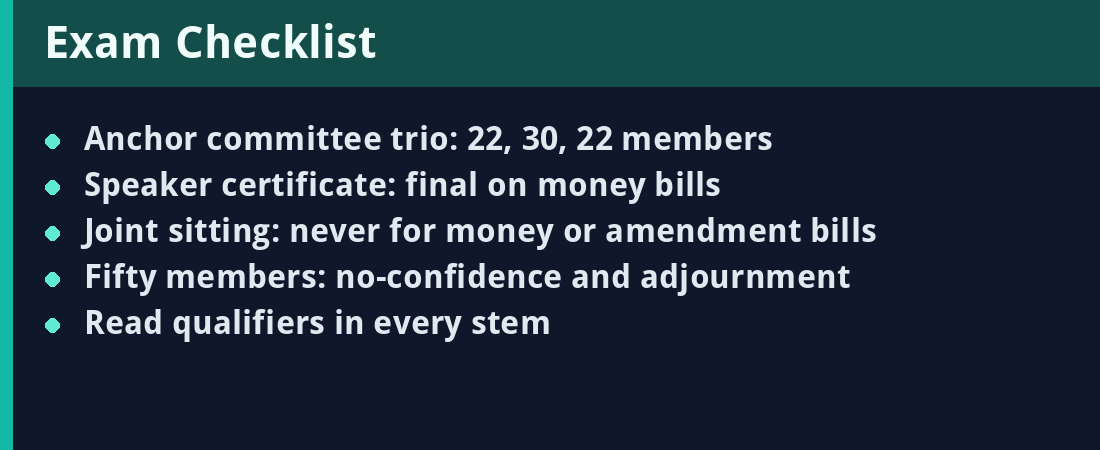
- Anchor committee trio: 22, 30, 22 members
- Speaker certificate: final on money bills
- Joint sitting: never for money or amendment bills
- Fifty members: no-confidence and adjournment
- Read qualifiers in every stem
Glossary in Five Lines
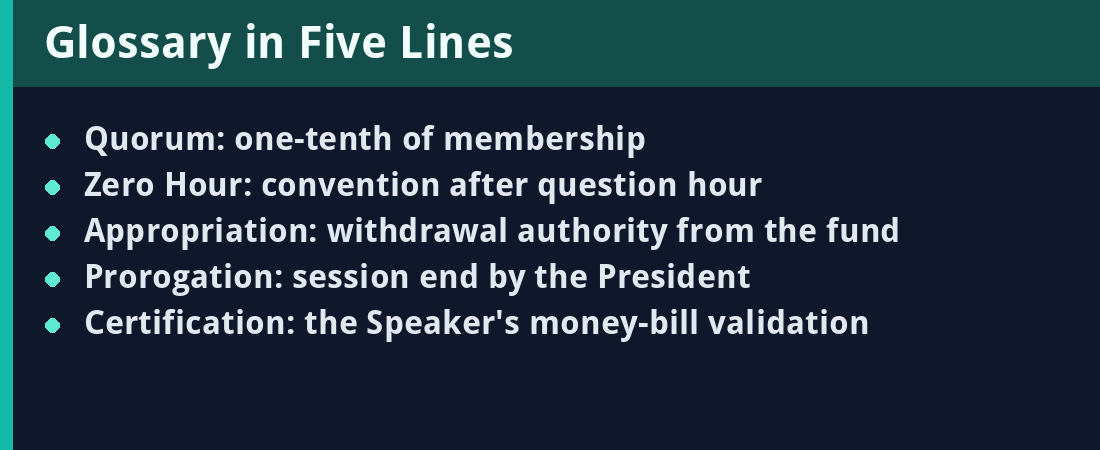
- Quorum: one-tenth of membership
- Zero Hour: convention after question hour
- Appropriation: withdrawal authority from the fund
- Prorogation: session end by the President
- Certification: the Speaker’s money-bill validation
The Thirty-Second Recap
One House chamber. Two committees. Three readings per bill. Therefore, anchor the trio first. Twenty-two, thirty, twenty-two. The Speaker certifies money bills. The committees do quiet work. However, qualifiers flip keys. So read each stem twice. Moreover, check the base of every number. Verify before locking. As a result, three silly marks return. Finally, polity is a bank zone. Bank it.
Explain It Simply: Parliament for a Twelve-Year-Old
Think of Parliament as a big school club with two rooms. One room is big. One room is small. The big room has more than five hundred seats. The small room has at most two hundred and fifty. Laws start as ideas. An idea is read three times. First, its name is read out. Then, it is talked about, line by line. Finally, the members vote. If both rooms agree, the idea becomes a law. However, some laws deal with money. For those, the big room holds all the power. The person who sits in the chair of the big room checks this. Her check is final. No one can question it.
The club also has small work groups. One group checks the bills. One group checks the plans. One group checks the firms run by the state. Each group has a fixed count of members. Moreover, the money group is led by someone from the side that lost the last vote. This is a fair-play rule from the year 1967. The SSC and UPSC papers love these small facts. Therefore, learn the counts as one chant: twenty-two, thirty, twenty-two. Finally, remember that both rooms must meet at least twice a year. The gap can never cross six months. That is the whole system in plain words. The framework is old, yet its validation rules still shape every law.
Parliament Rapid-Fire: Ten Answers in Ten Lines
- Who certifies a Money Bill? The Speaker, final under Article 110.
- Public Accounts Committee strength? 22 members, 15 from the Lok Sabha.
- Estimates Committee strength? 30 members, all from the Lok Sabha.
- Rajya Sabha ceiling? 250 seats, 12 nominated by the President.
- Quorum rule? One-tenth of the total membership of the House.
- Money Bill return window for the Rajya Sabha? 14 days.
- Joint sitting article? Article 108, never for Money Bills.
- First Lok Sabha Speaker? G. V. Mavalankar.
- Zero Hour status? A convention, not a constitutional text.
- Lok Sabha elective maximum after the 104th Amendment? 550.
Abbreviations That Recur in Parliament Questions
- LS: the Lok Sabha, the lower House of Parliament.
- RS: the Rajya Sabha, the upper House of Parliament.
- PAC: the Public Accounts Committee of twenty-two members.
- EC: the Estimates Committee of thirty members.
- CoPU: the Committee on Public Undertakings, from 1964.
- MP: a member of Parliament, in either House.
- MLA: a member of a state assembly, often a distractor option.
- GS: the general studies papers where these facts also appear.
- UPSC and SSC: the commissions that examine this block most.
Key Takeaways
In conclusion, this 25-question set compresses the Parliament block into the exact prelims register: strength numbers, certification powers, committees, motions and House-exclusive powers. To summarize, master the qualifiers, anchor the 22-30-22 committee trio, and rehearse the Money Bill timeline cold. Therefore, treat every wrong answer here as a found mark, and walk into the paper with this block fully secured.
References: the Constitution of India (Articles 79-122), lok sabha and rajya sabha official websites, M. Laxmikanth’s Indian Polity for structure.
Quick revision
- After the 104th Amendment, the maximum elective strength of the Lok Sabha is: (a) 540, (b) 550, (c) 552, (d) 560
- The Rajya Sabha can have a maximum of: (a) 238 elected members, (b) 250 members total, (c) 245 members, (d) 252 members
- Who certifies a Money Bill? (a) President, (b) Finance Minister, (c) Speaker, (d) Attorney General
- Under Article 249, the Rajya Sabha can legislate on a state subject with: (a) simple majority, (b) two-thirds majority present and voting, (c)…
- A no-confidence motion requires the support of at least: (a) 25 members, (b) 50 members, (c) 100 members, (d) one-tenth of members
- The quorum to constitute a sitting of either House is: (a) one-tenth of total membership, (b) one-third, (c) 100 members, (d) one-fifth
Have a doubt on this topic?